
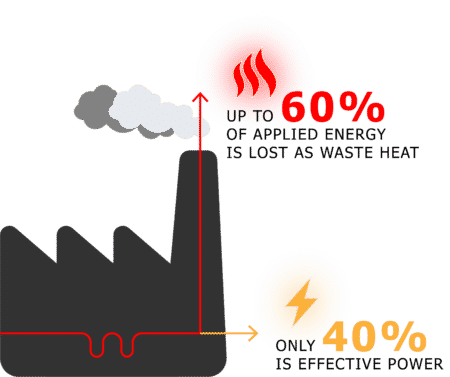
Up to 60% of energy generated is lost as waste heat. Developing a universal model for use of solid polymer electrolytes in thermogalvanic cells is a clear way to greatly increase global energy efficiency, saving money for companies, and decreasing the global environmental footprint.
“An alternative, for low-grade waste heat recovery, is thermogalvanic cells that rely on ion transport due to the Soret Effect and an electrochemical reaction to generate electricity.”(Mentor et al. 2020)

In electrochemistry, a thermogalvanic cell is a kind of galvanic cell in which heat is employed to provide electrical power directly.
Chum, HL; Osteryoung, RA (1980). “Review of thermally regenerative electrochemical systems. Volume 1: Synopsis and executive summary”. Solar Energy Research Institute pp. 35–40.
The Soret effect is defined as the ratio of the thermal diffusion coefficient (the opposing diffusion to concentration-based diffusion) to the Fickian diffusion coefficient (once the gradient is removed).

The Soret Effect is measured at steady state, when the net flux is zero
