
Fourier Transform Infrared Spectroscopy – Attenuated Total Reflectance
Fourier transform infrared spectroscopy (FTIR) is a multi-faceted technique which can be used to find the infrared absorption, emission, and photoconductivity of solids, liquids, and gases (1). Other applications include identifying the presence of inorganic and organic compounds (through functional groups) in a sample from their IR ‘footprint’, as well as for surface characterization of nanoparticles, along with microscopy and imaging (2).
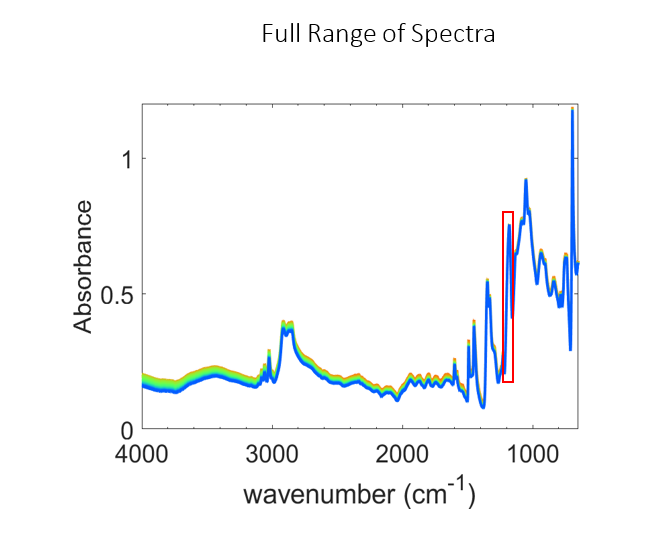
To the right is an example of the full range of spectra gathered from FTIR-ATR: from wavenumbers 4000-400, and the specified CF3 peak at 1215-1156 cm-1
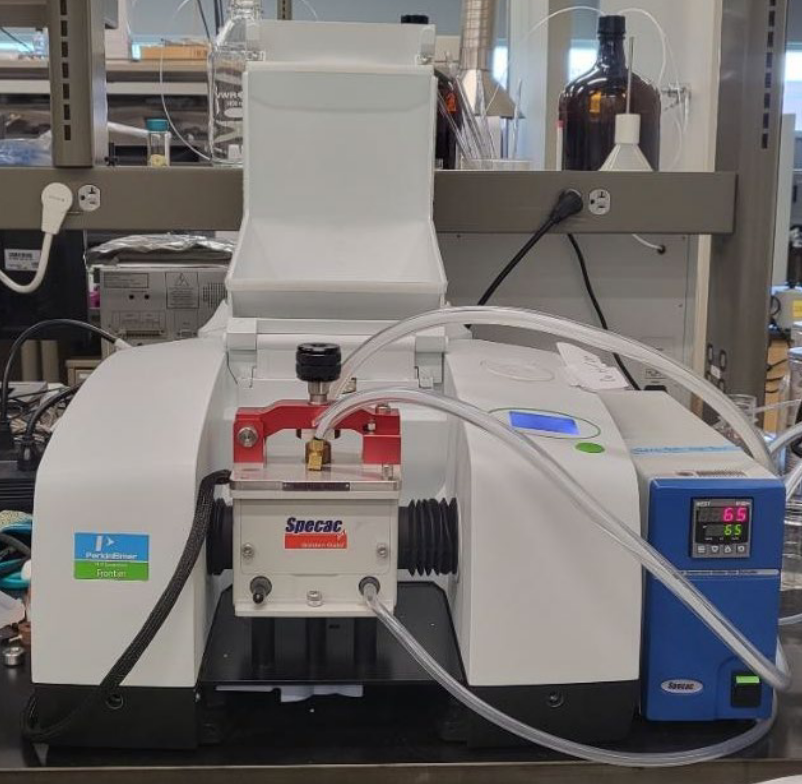
e working princi
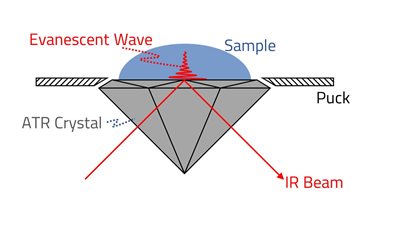
The working principal of the attenuated total reflectance (ATR) is shown in the image to the right. An IR beam is reflected off the surface of a crystal from below and touches with a sample of lower refractive index placed onto the surface of the crystal. Then, the intensity of the light reflected before and after a background scan, creates an IR absorbance spectrum, as shown in the figures below, of a certain sample.
