

Fick’s law states that the rate of diffusion of a substance across unit area (such as a surface or membrane) is proportional to the concentration gradient. (Basic Physics and Measurement in Anaesthesia (Fourth Edition), 1995)
This is an example of molecular diffusion, from two points of view. One shows the molecules moving separately, then the system as a whole. Once the ‘barrier’ is removed, the particles diffuse to the entirety of the container.
The solute diffuses from high concentration to low concentration

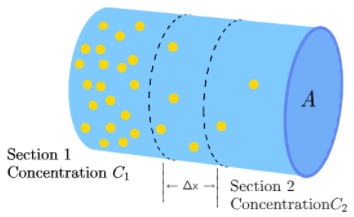
Fick’s Law applies to materials in all states: solids, liquids, and gasses. The solute moves to where there is a low concentration. In order to use Fick’s Law, it is necessary to assume pressure, and other forces are negligible.
valid for matter in all states; solid, liquid or gas. The diffused substance moves in the direction of decreasing concentration, (From high to low concentration.) Fick’s Law assumes that temperature, pressure or any other external forces are either not present or negligible. The diffusion coefficient depends on the temperature, pressure and the substances in the system. When ideal gases and dilute liquids are involved, the diffusion coefficient is assumed to remain constant in a given range of pressure and temperature
